
|
This page is still under construction |
Why reduction of biomass production
Waste water is usually treated in systems without biomass retention.
Concentrated and warm waste water could be treated without sludge retention in e.g. a chemostat.
This gives a very simple process design.
The biomass formed in a system without sludge retention exists of single suspended cells.
The more concentrated the waste water the more bacteria will be formed and the more money have to be paid to get rid of these bacteria.
These bacteria could be degradated by protozoa, who feed themselves with bacteria.
This principle could be realised by using a one-step process, in which bacteria and protozoa grow in the same reactor,
or by using a two-step process, in which the bacteria and the protozoa grow in two different reactors.
What are protozoa
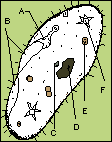 Protozoa are eukariotic unicellular animals which belong to the sub division of the kingdom of protists.
Two common classes are the flagellates and the ciliates.
Protozoa have evolved over a great time span.
This has resulted in many species that have adapted to all kinds of environment.
The size varies stongly not only between the different kinds but also inside a kind.
Protozoa found in waste water treatment processes normally have sizes between 5 and 300 micron.
Protozoa are eukariotic unicellular animals which belong to the sub division of the kingdom of protists.
Two common classes are the flagellates and the ciliates.
Protozoa have evolved over a great time span.
This has resulted in many species that have adapted to all kinds of environment.
The size varies stongly not only between the different kinds but also inside a kind.
Protozoa found in waste water treatment processes normally have sizes between 5 and 300 micron.